
Gamified learning apps
A gamified learning app turns a training objective into something a team plays rather than sits through. We build them from scratch for a single client and a single objective, then run them live: your people on their own phones, a facilitator driving the session, scoring as it happens, and a debrief that ties every decision back to how the team actually works.
Most of what gets sold as gamification is points, badges and a leaderboard bolted onto an e-learning module. It lifts completion rates for a while and changes almost nothing about behaviour. The mechanic rewards finishing, not thinking, so people optimise for finishing.
What we build is a different object. The game is the training. Teams face a situation with real pressure and incomplete information, make decisions together, and then find out what those decisions revealed about them. The app exists to create the experience and to make the debrief specific.
| Off-the-shelf gamification | A game built for you | |
|---|---|---|
| What is rewarded | Completing modules, streaks, quiz accuracy | The quality of a decision under pressure |
| Content | Generic scenarios, lightly re-skinned | Your situations, your vocabulary, your failure modes |
| Who runs it | Nobody. It runs itself | A facilitator, live, with the ability to intervene |
| What you learn about the team | Who finished | Who escalated, who went quiet, who checked |
| Where the learning lands | The score screen | The debrief afterwards |
| Reusability | Runs forever, ages fast | Built for a moment, reusable each intake |
The last row matters more than it looks. A generic platform has to be vague enough to suit everyone, which is exactly what makes it forgettable. A game written around your induction, your product, your regulatory pressure or your merger is specific enough that people talk about it afterwards.
Every game we have built shares the same spine, whatever the story on top of it:
The activity is the hook. The debrief is where behaviour changes. An app that skips the debrief is a quiz with better graphics.
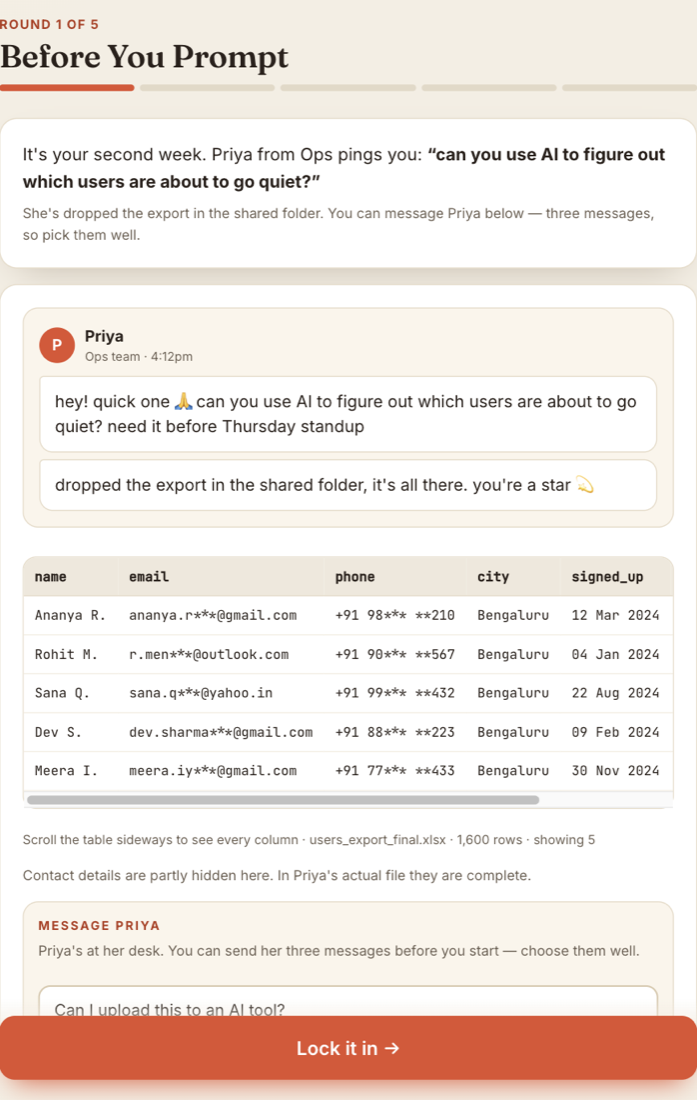
Five rounds, ninety minutes, written for new joiners. Teams work a live case on their phones and decide what to trust, what to verify, and what to own, in a world where a confident answer is cheap to produce. They can question the people in the case in their own words rather than picking from a menu, which is where most of the interesting behaviour shows up.
The facilitator sees every team's reasoning live and releases each reveal simultaneously. It ends on a scoreboard built on judgment rather than speed.
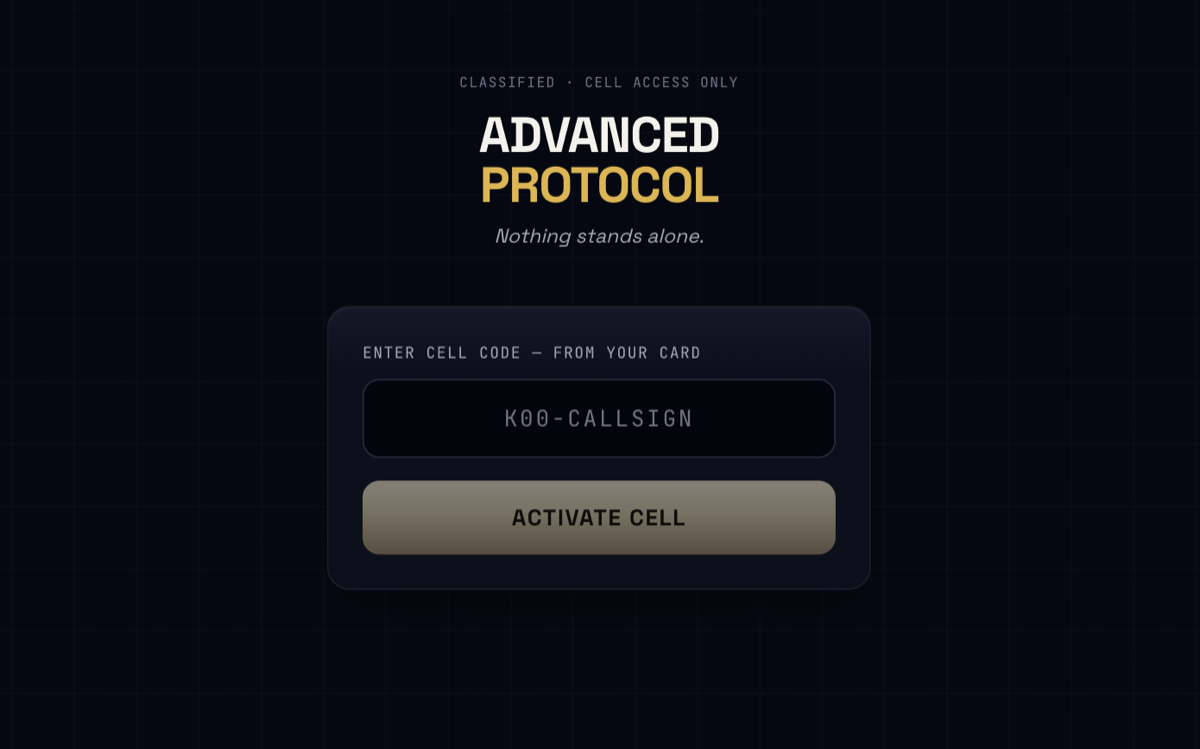
Two hundred new joiners, sixteen teams, four clusters, five levels. Its defining feature is that it runs in two halves at once: mental ops happen inside the app, where ciphers and deduction have to be cracked before anything unlocks, and physical ops happen away from the screen, run by facilitators. Solve the puzzle, earn the passcode, unlock the next level.
A live cluster leaderboard runs on the main screen all day, and the whole structure builds to a single reveal about the company they have just joined. Hybrid is not a compromise here, it is the design: the phone cannot deliver a room full of people shouting at each other, and the physical challenge cannot deliver a synchronised reveal.
Three cases where we will say so:
Four of ours are public and free. <a href="/weekly-challenge">The Weekly Challenge</a> is a ten-minute crisis week you play solo or with a team, ending in the same kind of debrief we build into commissioned games. <a href="/negotiation-room">The Negotiation Room</a> puts you through one client renewal in three scored rounds. The <a href="/icebreaker-generator">icebreaker generator</a> and the <a href="/feedback-builder">SBI feedback builder</a> are smaller things entirely, but they will tell you whether our idea of a useful tool matches yours. And <a href="/division-of-labour">The Division of Labour</a> is the argument for why any of this matters now.
If you want to understand the method before the software, experiential learning is the underlying model and facilitation is the skill that makes any of it work.
Tour De Force runs this as live, experiential training for teams worldwide — online and in person. Talk to us, or play The Weekly Challenge from our gamified learning apps to see the method in ten minutes.
Questions
A gamified learning app is a purpose-built game that runs a training session: participants play on their phones, the mechanics carry the learning objective, and a facilitator drives the rounds live. It differs from gamified e-learning, which adds points and badges to an existing course. In a gamified learning app the decisions inside the game are the content, and the debrief afterwards turns what happened into something the team can use.
An application that delivers a training objective through gameplay rather than instruction: participants make decisions inside a scenario and learn from the consequences. In a corporate setting the strongest versions are team-based and facilitator-led, with the app creating the experience and a debrief turning it into transferable learning.
Conventional gamification adds points, badges and leaderboards to existing content to increase completion. A bespoke learning game makes the decision itself the content. The first rewards finishing a module; the second rewards judgment, and produces evidence a facilitator can use in a debrief.
No. Everything runs in a mobile browser. Participants open a link and enter a team code, so there are no installs, accounts or app-store approvals to arrange before an event.
We have run a game for two hundred participants in sixteen teams across four clusters, with live scoring throughout. The structure scales by adding teams and clusters rather than by changing the game, and small intact teams work equally well.
Yes, and that is usually the point. The scenario is written once and re-run for each cohort. Because the interesting output is what a particular group did rather than a fixed answer, the same game produces a different debrief every time it runs.
It depends far more on the design than the code: agreeing the objective, writing the scenario and the debrief takes longer than building the app around it. The honest answer is that it is a project with a lead time, not something that can be arranged for next week, and we will tell you early if your date is not realistic.
Not always. If you need knowledge transfer, or nobody will facilitate the session, a platform or a good document is better value. It becomes worth it when the objective is judgment or culture, when the cohort is large enough for the cost to spread across intakes, and when you want something people still reference months later.
Keep reading
Play one of ours: a crisis week, seven decisions, and a debrief on how you led.
Free · 5 minutesOne client renewal, three rounds, and a scored breakdown of the tactics you reached for.
GlossaryThe model underneath all of it, and why practice beats being told.
ProgrammesThe physical half of the same philosophy: real challenge first, debrief second.
Get in touch
Book a 30-minute call. We will tell you honestly whether a bespoke game is the right instrument for your objective, or whether something simpler would do.
Book a discovery call →